What does months of inventory mean, and why should you care if you’re buying or selling in Denver?
Months of inventory tells you how long it would take to sell every home on the market in the Denver metro if no new listings came on. It’s the quickest way to see who has the upper hand: buyers or sellers.
I get asked “is it a buyer’s market or a seller’s market?” almost every week. Honestly, the answer usually isn’t one word. It depends on your price point, your property type, and even your part of town. Months of inventory is the number I lean on to give you a real answer instead of a headline.
The best part? Once you understand it, you’ll read every market update differently. Let’s break it down in plain English, then talk about what it means for your next move here on the Front Range.
How Months of Inventory Works
Think of it like a pantry. If you have 30 cans on the shelf and you use 10 a month, you have three months of supply. Real estate works the same way: take the number of homes for sale and divide it by how many homes are selling each month.
So if a Denver neighborhood has 30 homes listed and about 10 go under contract each month, that’s three months of inventory. If sales slow to 5 a month with the same 30 listings, it jumps to six months. Same homes, very different market.
Analysts calculate it a few slightly different ways. ShowingTime explains that a common method divides current inventory by a rolling 12 month average of pending sales, which smooths out seasonal swings. The idea stays the same: supply compared to demand.
What the Numbers Tell You
Here’s the general rule of thumb most of the industry uses:
| Months of inventory | What it usually means | Who has more leverage |
|---|---|---|
| Under 4 months | Seller’s market | Sellers |
| About 4 to 6 months | Balanced market | Pretty even |
| Over 6 months | Buyer’s market | Buyers |
Under four months, homes move quickly and multiple offers are more common. Over six, buyers have time to compare, negotiate and ask for help with costs. In between, it comes down to price, condition and strategy.
What It Looks Like in Denver Right Now
The latest DMAR Market Trends Report for October 2026 shows exactly why one market wide label doesn’t tell the whole story. A few things stood out:
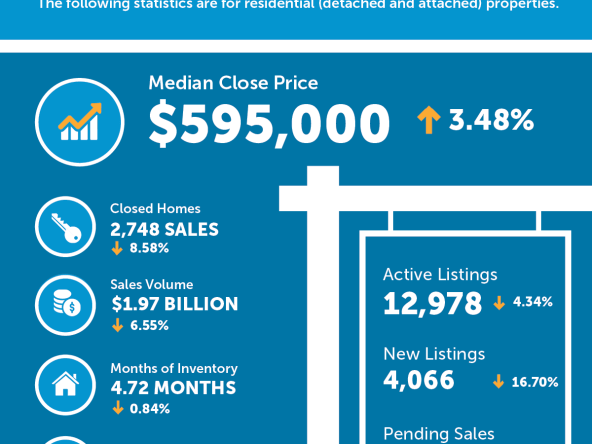
- Active listings across the Denver metro hovered around 13,000.
- Closings came in at 2,748, the fewest for an October since 2010.
- Condos and townhomes had more than seven months of supply, with a median of 48 days on the market.
- Single family (detached) homes sold in a median of 26 days.
- About 65% of homes that sold included a seller concession.
Read that again with the table above in mind. Condos and townhomes are sitting firmly in buyer’s market territory, while detached homes are still moving much faster. Two very different markets, same city, same month.
For a deeper look at the month, check out my Denver Market Update for October 2026.
Why Your Slice of the Market Matters Most
Metro wide numbers are a starting point, not your answer. A condo near Cherry Creek, a townhome in Aurora, and a detached home in Arvada can all live in completely different markets at the same time.
When I pull months of inventory for a client, I narrow it down by:
- Property type: condo, townhome or detached home.
- Price range: the supply picture at $500,000 can look nothing like it does at $1.5 million.
- Location: a specific neighborhood, zip code or county, like Denver, Jefferson or Arapahoe County.
That’s when the number gets really useful, because it’s about your home, not the average home.
What It Means If You’re Selling
Low inventory in your segment gives you more room on price and terms. Higher inventory means buyers have options, so your home needs to stand out on day one.
- Price based on your segment’s supply, not on what a neighbor got two years ago.
- In a higher supply segment, condition and presentation carry more weight.
- Plan ahead for concessions, since many buyers are asking for them right now.
What It Means If You’re Buying
Higher inventory is your friend. It usually means more time to decide, more room to negotiate, and a better shot at help with closing costs or a rate buydown.
- In a high supply segment, ask about concessions and repairs with confidence.
- In a low supply segment, be ready to move quickly with your financing lined up.
- Watch how long similar homes have been sitting. Days on market and inventory tell the story together.
Got more questions about how all this works? My Denver Real Estate FAQ and Market Insights page are great next stops.
Frequently Asked Questions
What is a balanced market in months of inventory?
Most of the industry considers about four to six months of inventory a balanced market. Under four leans toward sellers, and over six leans toward buyers.
Is Denver a buyer’s market right now?
It depends on what you’re buying. In October 2026, Denver metro condos and townhomes had more than seven months of supply, which favors buyers, while detached homes sold in a median of 26 days.
How can I find months of inventory for my neighborhood?
A local agent can pull it from MLS data for your exact property type, price range and neighborhood. Reach out and I’ll run it for you.
Let’s Look at Your Numbers
Curious where your home fits in today’s Denver market? Start with a free home value estimate, or reach out here and I’ll pull the months of inventory for your exact neighborhood and price point. You can also email me at stacey@savvy-group.co or call or text 720.371.4895.
Stacey Stambaugh
The Savvy Group at Compass